Davos, Switzerland | January 2026
As part of Smart Cities Council’s official program at WEF Davos 2026, the SCC Welcome Reception in Zurich brought together leaders from government, industry, finance, and academia for an evening focused not on ambition, but on execution.
Opening the evening, SCC President Corey Gray anchored the discussion in a simple but powerful truth: transformation starts with people and trust. Without trusted institutions, capable teams, and confidence in execution, even the most compelling strategies fail to translate into outcomes.
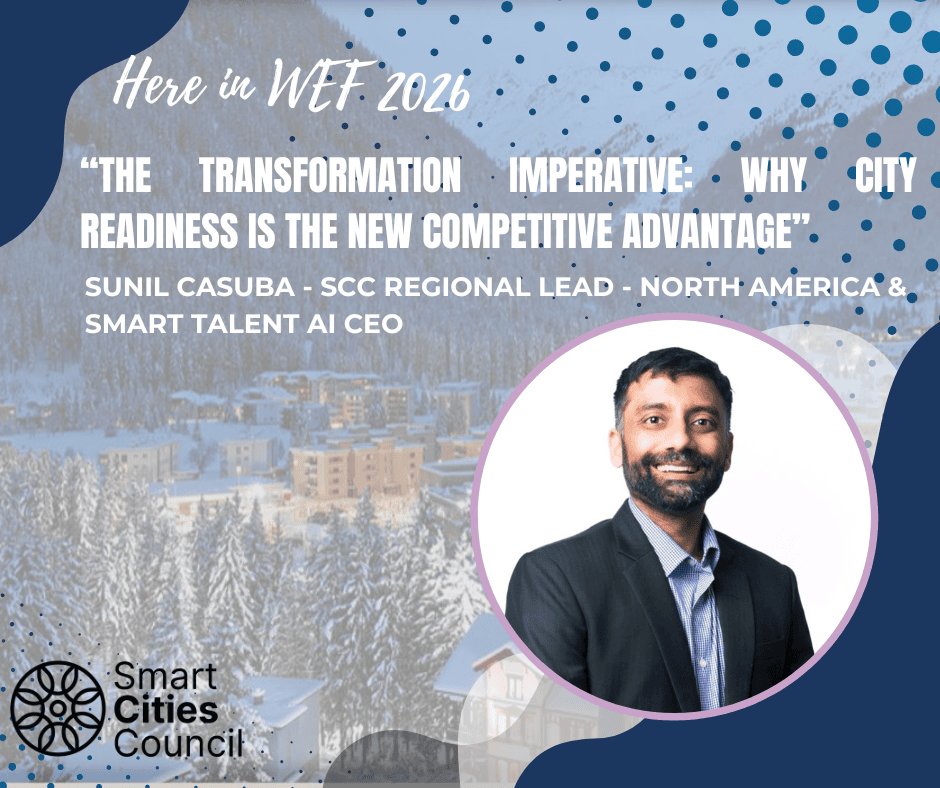
That framing set the tone for the first panel of the evening, “The Transformation Imperative – What Capability Do Cities Need to Be Ready for the Changes to Come?” moderated by Sunil Casuba, and featuring Douglas Hammer, Charles Austen Angell, and Dr Melissa Grill-Petersen.
The discussion made one thing clear—urban transformation rarely fails because cities lack vision. It fails because they lack readiness.
Cities today are navigating unprecedented complexity: accelerating technological change, rising community expectations, governance fragmentation, infrastructure strain, and workforce disruption. Yet too often, transformation efforts stall not at the strategy stage, but at implementation, where institutions struggle to adapt at speed and at scale.
A central theme of the conversation was capability and workforce readiness. Panellists emphasised that the current talent gap is not simply a shortage of technical skills, but a structural mismatch between how roles are designed and the realities of an AI-enabled era. Many public sector organisations are still operating with job descriptions, operating models, and hiring processes built for a pre-AI world, even as the nature of work has fundamentally changed.
What is most scarce today is not pure engineering talent, but “translators”, people who can bridge policy and technology, operations and data, leadership intent and real-world implementation. These hybrid capabilities are essential for turning innovation into outcomes.
At the same time, speakers acknowledged a hard reality for cities and public institutions: they will never compete with private-sector salaries. However, they often underinvest in the one lever fully within their control, developing clear capability pathways for the people they already have. Replacing staff is expensive; upgrading them is strategic.
This workforce challenge sits at the heart of readiness maturity. The panel explored readiness not as a static benchmark, but as a continuous journey, one that spans governance, data maturity, institutional capability, and strategic alignment. Without this foundation, cities risk locking in inefficiencies through well-intentioned master plans and technology deployments that fail to deliver long-term, regenerative outcomes.
Maturity and readiness assessments, panellists argued, allow city leaders to understand where they are today, prioritise interventions, and sequence transformation deliberately. This enables leapfrogging rather than incremental change—moving faster by focusing on the right capabilities at the right time.
Throughout the discussion, Smart Cities Council’s role was positioned clearly: to turn readiness into execution. SCC acts as an enablement platform, connecting cities with the right partners, tools, and pathways to accelerate adoption of smart targets, smart practices, and smart technologies—always in service of measurable outcomes for people and place.
As the evening concluded, the message was unequivocal. In a world defined by rapid change and rising expectations, readiness is no longer optional. It is the new competitive advantage—and it starts with people, trust, and the capability to deliver.
Media interested in attending or scheduling interviews should contact:
Karen Norden karen.norden@smartcitiescouncil.com
About Smart Cities Council
Smart Cities Council is a global network of cities, governments, technology leaders, investors, and solution providers dedicated to enabling city and community transformation through governance, finance, technology, and partnerships that deliver measurable outcomes.
For more information on Smart Cities Council programs: