Davos, Switzerland | January 2026
At WEF Davos 2026, conversations around cities, technology, and investment are everywhere. What is far rarer is a discussion that challenges the very definition of progress and success.
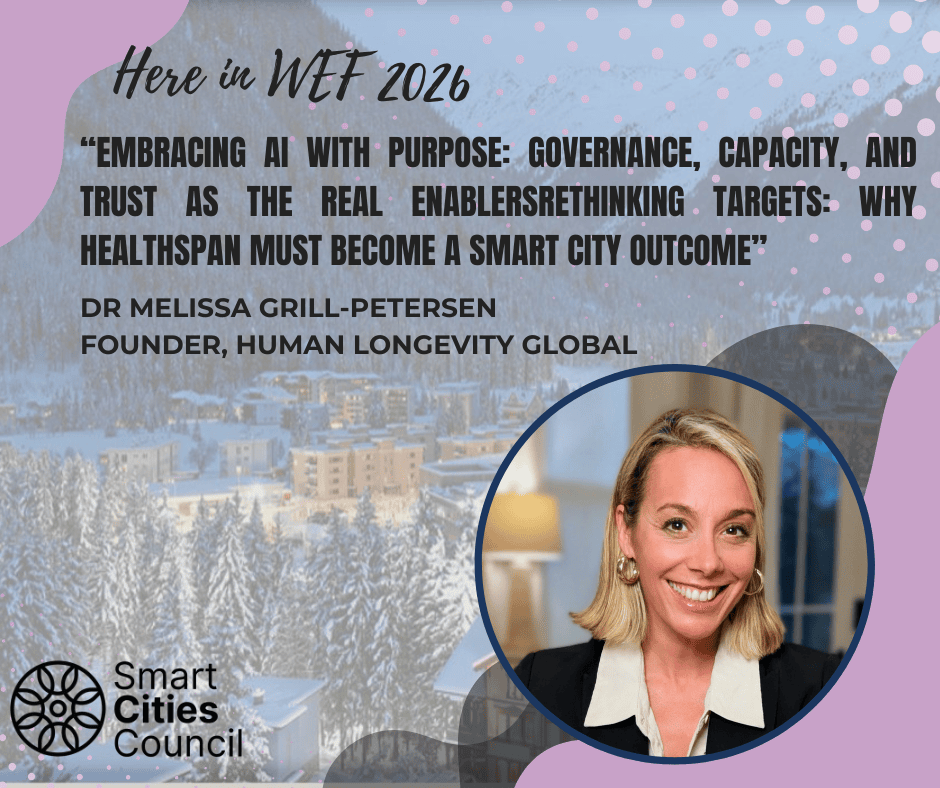
During the Smart Cities Council (SCC) Welcome Reception, following the opening address by SCC PresidentCorey Gray, a dedicated panel posed a critical question: What if cities are measuring the wrong things altogether?
The panel, “Rethinking Targets to SMART Outcomes,” explored why healthspan — the number of years lived in good health — must become a core SMART city outcome for long-term resilience, productivity, and trust.
Moderated by Dr Melissa Grill-Petersen, the session featured Indu Navar, Charles Austen Angell, and Dr Richard Bergstrom, bringing together expertise in AI, systems intelligence, digital health, and patient-driven research.
Dr Grill-Petersen framed healthspan as a measurable, cross-sector metric, highlighting that average health decline begins around age 65 and that human life expectancy may reach 120 years. Yet most societies fail to reach this potential due to late intervention and fragmented systems.
The panel argued that traditional systems reward treatment over prevention and short-term outputs over long-term wellbeing. This has created a widening gap between lifespan and quality of life, revealing deep structural weaknesses in healthcare and urban planning.
Indu Navar shared her personal journey following the loss of her husband to ALS and described how citizen-driven research and collaborative platforms can accelerate early diagnosis and treatment. She emphasised that health innovation must be built on trust, neutrality, and shared data.
Richard Bergstrom highlighted the importance of user-centred design, noting that meaningful innovation must account for the lived experiences of patients and practitioners. He stressed that empathetic systems, not just advanced technology, are essential for improving outcomes.
The discussion also addressed the critical role of data quality. Panellists agreed that collecting information alone is insufficient; data must be translated into actionable insights through robust methodology and collaborative platforms.
A recurring theme was the need to shift healthcare from an intervention-based model to one focused on early sensing, prevention, and resilience. This transition, the panel noted, would not only improve individual wellbeing but reduce long-term societal and economic costs.
Crucially, the panel made clear that prioritising healthspan does not mean rejecting innovation. Instead, it demands better innovation — where AI, digital health tools, and data systems are aligned with dignity, equity, and human capability.
Smart Cities Council positions healthspan as a truly SMART objective: specific, measurable, actionable, relevant, and time-bound. Cities that embed healthspan into policy, investment, and infrastructure decisions are not only healthier — they are more productive, resilient, and attractive to long-term investment.
As the session concluded, panellists agreed that improving healthspan requires coordinated action across government, industry, healthcare, and communities. By reframing success around human wellbeing, cities can move beyond narrow efficiency metrics and build systems that genuinely support thriving, connected populations.
Media interested in attending or scheduling interviews should contact:
Karen Norden karen.norden@smartcitiescouncil.com
About Smart Cities Council
Smart Cities Council is a global network of cities, governments, technology leaders, investors, and solution providers dedicated to enabling city and community transformation through governance, finance, technology, and partnerships that deliver measurable outcomes.
For more information on Smart Cities Council programs: