
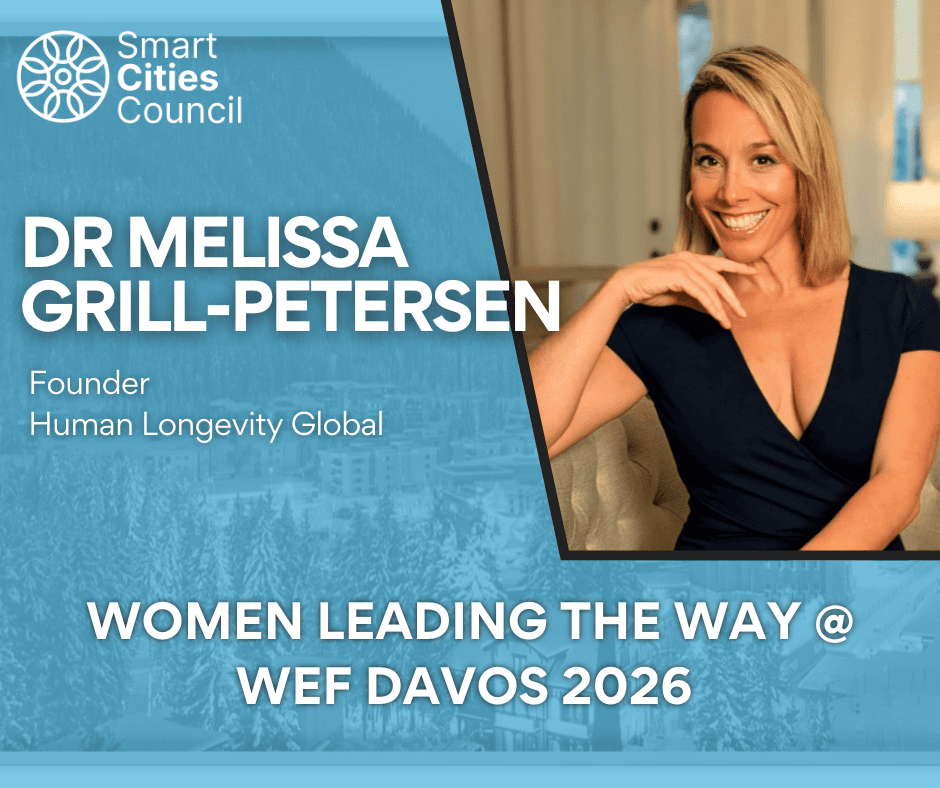
Davos, Switzerland | January 2026
As part of Smart Cities Council’s delegation to WEF Davos 2026, SCC is launching a series spotlighting women who are not only breaking the glass ceiling — but reshaping the systems that sit beneath it.
In the first feature, Dr Melissa Grill‑Petersen, Founder and CEO of the Human Longevity Institute, challenges one of the most persistent blind spots in city planning: treating health as a downstream cost rather than foundational infrastructure.
Melissa’s leadership reframes healthspan — not lifespan — as a core pillar of city readiness, intersecting with AI governance, digital infrastructure, workforce productivity, and long-term economic resilience. Her work makes a compelling case that cities designed for longer, healthier lives are also cities better equipped to thrive.
At WEF Davos 2026, Melissa represents a growing movement of leaders pushing cities beyond aspiration and toward measurable outcomes — where wellbeing, technology, and policy are designed together.
As cities face mounting pressure from ageing populations, workforce productivity challenges, and escalating healthcare costs, healthspan — not lifespan — is emerging as one of the most critical policy and investment priorities of the decade.
Speaking ahead of Smart Cities Council’s Davos 2026 program, Dr Melissa Grill-Petersen, Founder and CEO of the Human Longevity Institute, outlines why cities must urgently rethink how health, technology, and governance intersect.
“Healthspan is not a medical issue alone,” Dr Grill-Petersen explains. “It’s an economic, social, and infrastructure challenge. Cities that fail to plan for it will struggle with productivity, equity, and long-term resilience.”
Her work focuses on translating cutting-edge longevity science into scalable, real-world systems — particularly through AI-enabled prevention, early intervention, and data-driven health decision-making. In an urban context, this means embedding healthspan into city design, digital infrastructure, workforce planning, and public-private investment models.
At Davos 2026, Smart Cities Council is positioning healthspan as a core pillar of city readiness, alongside AI governance, data infrastructure, and blended finance. The message is clear: cities that treat healthspan as foundational infrastructure — rather than a downstream healthcare cost — will be better equipped to thrive in an era of demographic change.
Dr Grill-Petersen’s contribution reinforces SCC’s broader mandate at Davos: moving cities from ambition to measurable outcomes by aligning policy, technology, finance, and leadership around shared priorities.
Healthspan, when enabled by AI and sound governance, is not just about individual wellbeing — it is about building cities that are productive, inclusive, and resilient for generations to come.
Catch more of what Indu has to say here.
Media interested in attending or scheduling interviews should contact:
Karen Norden karen.norden@smartcitiescouncil.com
About Smart Cities Council
Smart Cities Council is a global network of cities, governments, technology leaders, investors, and solution providers dedicated to enabling city and community transformation through governance, finance, technology, and partnerships that deliver measurable outcomes.
For more information on Smart Cities Council programs: