Davos, Switzerland | January 2026
As part ofSmart Cities Council’s official program at WEF Davos 2026, the SCC Welcome Reception in Zurich brought together leaders from government, industry, finance, and academia to focus on a critical shift: moving from ambition to execution.
Opening the evening, SCC President Corey Gray anchored the discussion in a simple but powerful truth: transformation starts with people and trust. Without trusted institutions, capable teams, and confidence in execution, even the most compelling strategies fail to translate into outcomes.
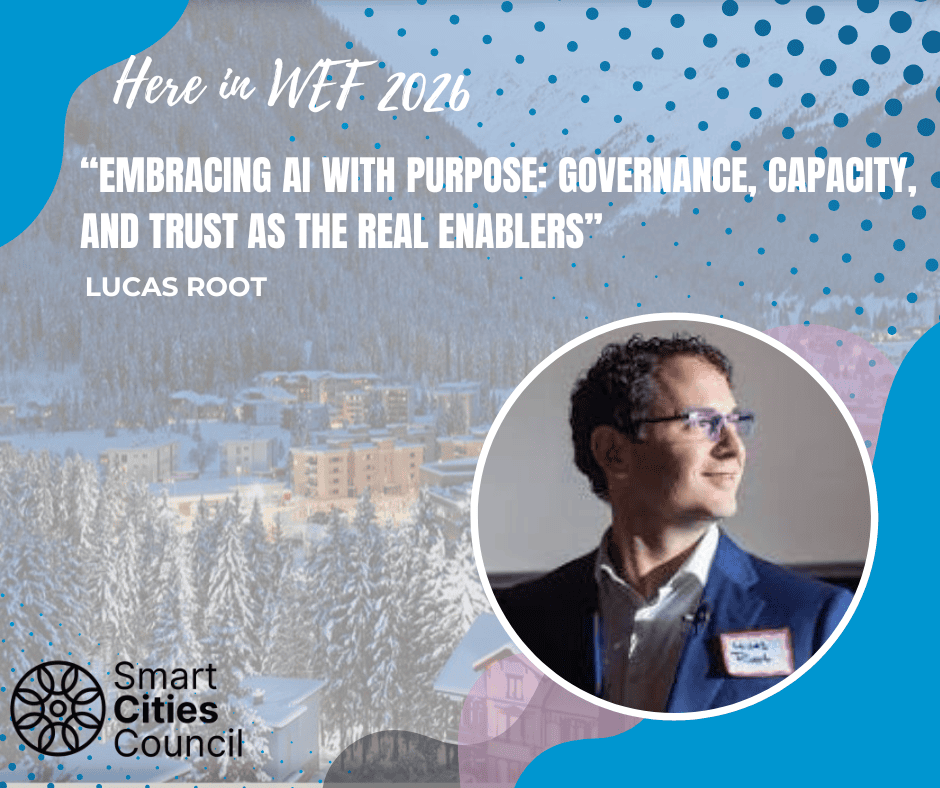
That framing set the tone for the panel “The Transformation Imperative – What Capability Do Cities Need to Be Ready for the Changes to Come?” moderated by Lucas Root, who deliberately steered the conversation away from technology hype and toward first principles. Root positioned AI not as a standalone solution, but as a systems challenge—one that requires cities to rethink governance, infrastructure, and public trust before scale is possible.
From that foundation emerged the panel’s central insight: AI is not plug-and-play. It is a system re-architect. Scaling it in cities requires what panellists described as the “Scalability Stack”—three interdependent pillars that must move together: governance, computational capacity, and citizen acceptance.
Robust governance was reframed not as a brake on innovation, but as a speed enabler. Shaik Hamdan emphasised that governance builds the trust that allows cities to move fast with confidence, while Dr Adel Elmessiry argued for computable governance—embedding rules and ethics directly into AI systems so compliance becomes automatic rather than procedural. When governance is part of the architecture, cities don’t have to slow down to check it.
The discussion then turned to computational capacity, often overlooked in AI strategies. Stephania Stavropoulos highlighted that real-time cities cannot rely solely on distant cloud infrastructure. Processing must increasingly happen at the edge, close to where data is generated, to enable speed, resilience, and privacy. Shaik reinforced the importance of sovereign compute, arguing that cities can no longer outsource their intelligence entirely—compute is now a core urban utility. The conclusion was clear: scalability is ultimately a hardware problem. No chips at the edge means no real-time city.
The final pillar focused on citizen acceptance. David Sprinzen reframed AI as a service partner rather than a surveillance tool, pointing to agentic AI that solves real problems such as emergency response and disaster alerts. Stephania added that technology must behave like a guest in the city—respecting local culture, values, and privacy norms. Acceptance, the panel agreed, is earned through demonstrated benefit, not assurances alone.
The discussion closed with a forward-looking synthesis. When cities get the Scalability Stack right, AI stops being the driver of transformation and becomes its accelerator. Cities move from operating tools to directing outcomes—improved healthspan, stronger resilience, and systems that adapt to people, not the other way around.
In a world defined by rapid change and rising expectations, the message was unequivocal: readiness is no longer optional. It is the new competitive advantage—and it starts with people, trust, and the capability to deliver.
In this framing, AI’s true value is not in automation, but in amplification, enabling cities to move faster, fairer, and with greater confidence toward outcomes that matter for people and place.
Media interested in attending or scheduling interviews should contact:
Karen Norden karen.norden@smartcitiescouncil.com
About Smart Cities Council
Smart Cities Council is a global network of cities, governments, technology leaders, investors, and solution providers dedicated to enabling city and community transformation through governance, finance, technology, and partnerships that deliver measurable outcomes.
For more information on Smart Cities Council programs: