
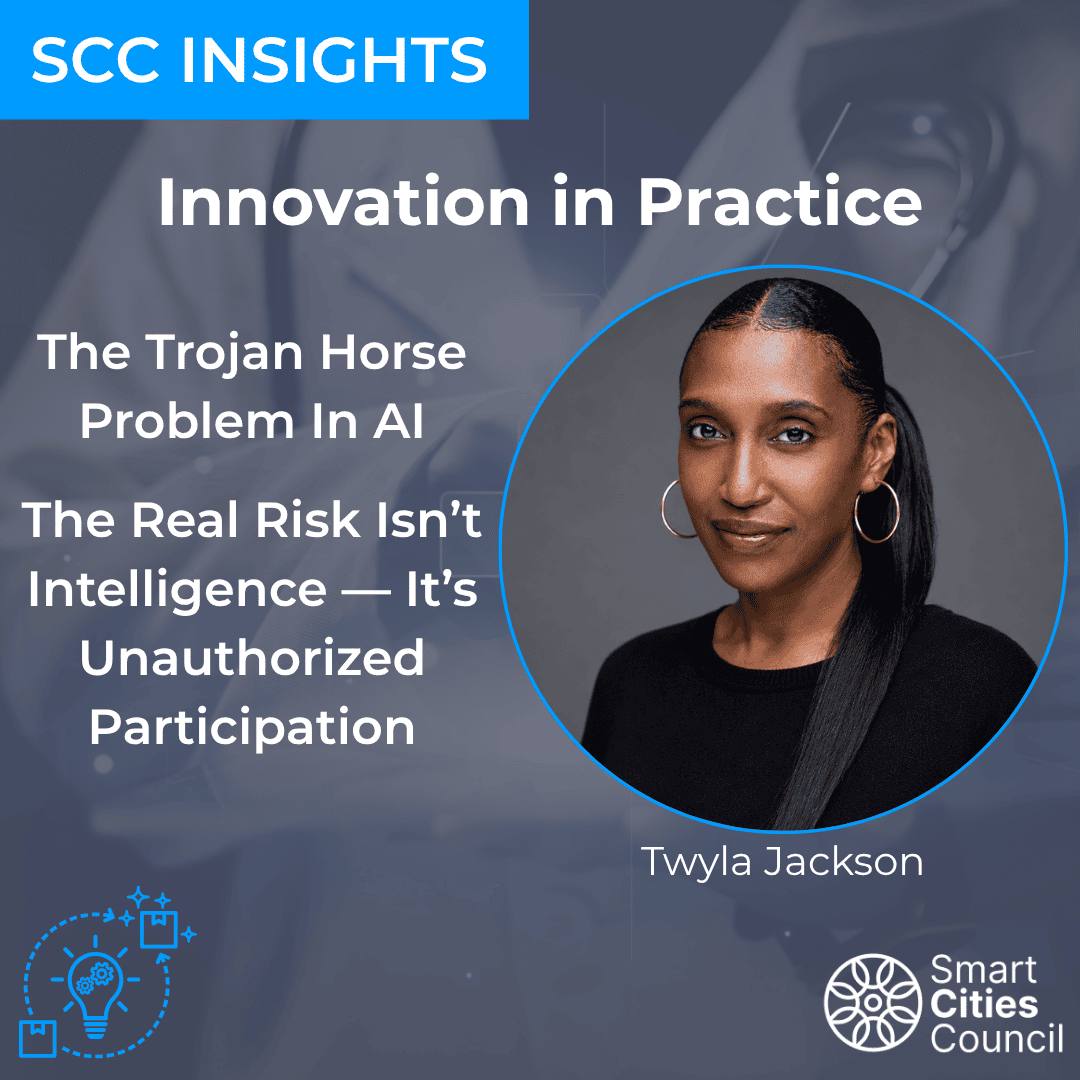
Founder & CEO, Helixis Technology
The technology industry keeps warning society about intelligent machines. That may prove to be the wrong threat entirely. The larger risk may emerge from something far less dramatic: machines automatically trusting other machines inside environments humans depend on. Not because the systems are malicious. Because the systems are connected.
That distinction changes the AI conversation completely.
Right now, autonomous systems are evolving from tools into participants. Vehicles negotiate with infrastructure. Algorithms negotiate with algorithms. AI agents exchange permissions, priorities, and operational decisions continuously. Increasingly, those interactions occur without direct human review.
Most people call this efficiency.
History may eventually describe it differently: the largest infrastructure trust experiment civilization has ever conducted.
Because once autonomous systems begin interacting independently, society inherits a problem older than technology itself: Who is allowed inside trusted space?
That is why the future of AI increasingly resembles the logic behind the Trojan Horse. The lesson was never simply about deception. It was about unauthorized participation.
Troy did not collapse because the walls failed. Troy collapsed because something entered trusted infrastructure without proper verification. The horse was accepted as legitimate.
That is the part most AI discussions still miss.
The defining issue of the autonomous era may not be intelligence. It may be legitimacy.
For decades, the technology industry optimized for frictionless participation: frictionless connectivity, frictionless communication, frictionless commerce, frictionless scale. If systems could connect, they connected. If systems could exchange information, they exchanged it. Economically, that philosophy transformed the world.
But civilization has never actually operated on frictionless participation.
Banks require settlement rules before money moves. Aircraft require authorization before entering controlled airspace. Pharmaceuticals require approval before entering public circulation. Nuclear facilities require layered access controls before systems are trusted inside critical environments.
Critical infrastructure has never operated on capability alone.
It operates on authorized participation.
That is the principle the autonomous era is beginning to collide with.
Because frictionless participation works well when systems behave like tools. It becomes dangerous when systems become participants.
Participants require boundaries. Participants require conditions. Participants require authority structures.
A bank’s fraud system cannot approve transactions simply because credentials appear valid. An aircraft cannot enter restricted airspace simply because its navigation systems are technically capable of doing so. A pharmaceutical company cannot distribute a drug simply because laboratory testing produced promising results. A nuclear facility cannot grant network access simply because a system authenticated successfully.
Capability is not legitimacy.
And intelligence is not authorization.
That may become one of the defining infrastructure realities of this century.
The problem is that innovation and governance operate at fundamentally different speeds. Innovation moves at software velocity.
Governance moves at institutional velocity.
That gap has already destabilized multiple industries. Social media scaled before information governance matured. Platform economies scaled before labor governance matured. The internet scaled before digital identity governance matured. Each time, institutions reacted after dependency had already formed.
Autonomous systems compress that timeline dramatically because machine-to-machine coordination occurs continuously and at machine speed.
The market still treats deployment as the primary objective. But civilization has never allowed unrestricted participation inside high-consequence systems.
Every infrastructure system society depends on eventually develops operational friction.
Not to stop progress.
To preserve legitimacy.
Air traffic control is friction. Financial compliance is friction. Pharmaceutical approval is friction. Cybersecurity authentication is friction.
The purpose of friction is not inefficiency. The purpose is determining what is safe enough, legitimate enough, and accountable enough to participate inside shared human environments. The autonomous era simply forces society to operationalize that principle at machine speed.
That is why the next critical infrastructure layer may not be artificial intelligence itself. It may be machine-readable governance: operational systems capable of determining who can participate, where, under whose authority, under what constraints, for how long, and with what consequences if systems fail.
That governance layer will almost certainly face resistance from parts of the technology industry precisely because friction slows scale. Friction slows monetization. Friction slows autonomous deployment. Friction slows unrestricted interoperability.
But the absence of friction inside civilization-scale systems has never eliminated risk. It has only redistributed risk downstream until society absorbs the consequences later.
The irony is that the companies moving fastest toward autonomy may ultimately depend most heavily on governance infrastructure.
Because autonomous systems cannot scale into civilization through intelligence alone. They scale through trusted participation.
And that is the deeper issue most AI debates still avoid.
The defining infrastructure battle of the autonomous era will not be over who builds the smartest systems. It will be over who defines the conditions under which intelligent systems are allowed to participate in civilization itself.
About the Author
Twyla Jackson is the Founder and CEO of Helixis Technology, a company focused on building the governance and trust infrastructure required for autonomous systems to safely operate within shared public environments. Working at the intersection of artificial intelligence, civic infrastructure, policy and operational accountability, her work explores how autonomous technologies can scale responsibly without outpacing public trust, governance or democratic oversight.
Drawing influence from NASA’s technology transfer ecosystem and advanced autonomy frameworks, Twyla advocates for “accountability before growth” and “reliability before scale” — positioning trusted participation, auditability and machine-readable governance as critical infrastructure layers for the autonomous era.
Through Helixis Technology, she works with industry, infrastructure operators, cities and emerging technology ecosystems to help shape systems that are explainable, governable and aligned with human policy and community expectations. Her thought leadership focuses on the future of trusted autonomy, public legitimacy, AI governance and the operational frameworks required to support next-generation smart infrastructure.