
Source: Adapted from NCS Australia article: "Sovereign AI in Australia: From compliance obligation to competitive advantage"
Artificial intelligence is quickly becoming part of how cities plan, operate and deliver services. From transport optimisation and asset management to citizen services, public safety, utilities and infrastructure planning, AI is moving from experimentation into the systems that shape everyday urban life.
That shift creates a new question for city leaders. It is no longer enough to ask whether AI can improve a service. The more important question is whether the city can control, govern and audit the AI systems it depends on.
This is where sovereign AI becomes important.
Sovereign AI is often misunderstood as a data residency issue: whether data is stored within national borders. Data location matters, but it is only one part of the picture. For public-sector and critical infrastructure environments, sovereignty is also about who has control over access, model behaviour, inference, auditability, supply chain risk and operational accountability.
For cities, this distinction matters because urban systems are increasingly connected. A single AI-enabled service may draw on data from transport networks, utilities, planning systems, customer channels, third-party platforms and operational technology. If that system cannot be explained, governed or contained within the right policy and security boundaries, it can quickly become a risk rather than an enabler.
In Australia, this issue is becoming more urgent as AI moves into regulated operating environments. Government policy obligations across security, privacy, critical infrastructure and responsible AI are raising expectations for how organisations manage access, provider risk and sensitive information. The direction is clear: AI must be designed for control from the beginning, not retrofitted after deployment.
The lesson for cities is practical. AI strategy, responsible AI and sovereign architecture should not be treated as separate workstreams. They need to be designed together.
A useful way to think about this is through four layers of control, as originally appears in this Sovereign AI in Australia piece
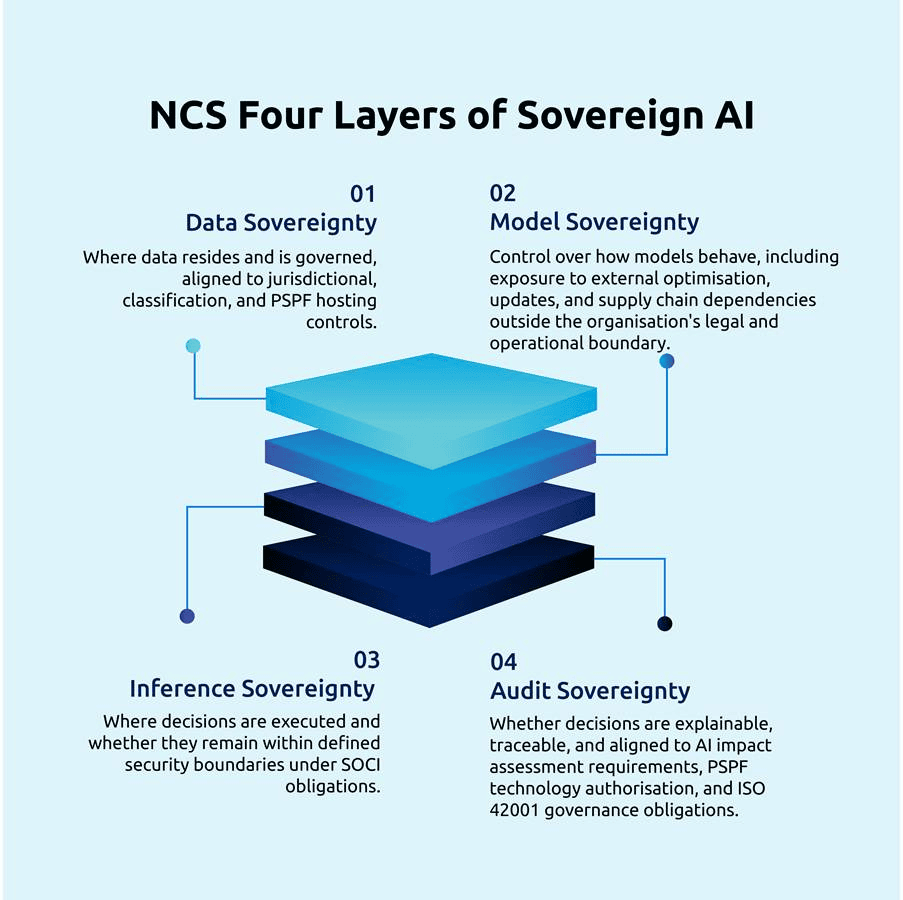
First is data: where information is stored, how it is classified and who can access it. Second is the model: how AI systems are selected, trained, tuned and monitored. Third is inference: where prompts, outputs and decisions are processed. Fourth is auditability: whether the organisation can demonstrate what happened, why it happened and who was accountable.
Many organisations have made progress on the first layer. Fewer have full visibility across all four.
For smart cities, that gap can become significant. A city may be comfortable that its data is hosted locally, but still lack clarity on whether an AI provider can access sensitive information, whether model outputs can be verified, or whether the system would withstand policy, procurement or audit scrutiny.
Practical takeaway
Before scaling AI into city operations, leaders should assess sovereignty across the full lifecycle of the system. That means looking beyond where data sits and asking how control is maintained across the architecture, operating model, governance framework and vendor ecosystem.
This does not need to slow innovation. In fact, it can accelerate it. Cities that build defensible AI foundations will be better placed to access high-value datasets, collaborate across agencies and scale use cases with confidence. Those that do not may face delays, redesigns or constraints when systems are tested against security and governance requirements.
What this means for cities
Smart city AI will only succeed if communities can trust it and public institutions can control it. Sovereign AI gives city leaders a framework for doing both.
The cities that move fastest will not be those that adopt AI most aggressively. They will be those that design AI systems that are secure, auditable, accountable and fit for the public environments they serve.
Want to know more?
Read more about Sovereign AI and how the NCS team of AI experts can help you begin by assessing your AI readiness across strategy, governance, and architecture.
NCS offers an integrated assessment across all four sovereignty layers, aligned to PSPF, ISM, SOCI, and DTA requirements.
One engagement. Full visibility across all four layers. A defensible path to production aligned to AU Government policy requirement. Contact us to find out more.