

There's a strange contradiction at the heart of the climate crisis. Every credible analysis shows the world needs trillions of dollars in new climate finance annually. Yet the policy tools on offer — carbon taxes, cap-and-trade, voluntary offsets — keep stalling, get watered down, or lose public support due to costs on businesses and households. The usual ways cities raise money also run into limits: borrowing against future revenue, charging more via utility bills, running loan funds, chasing national grants, or bringing in private partners. For city leaders and infrastructure executives planning decades ahead, this is more than an abstract frustration. It's why bankable, long-horizon projects — such as electrification, grid modernisation, and nature-based mitigation — sit on the shelf waiting for capital that never arrives.
My research, just published in its fourth version, argues this isn't simply a failure of political will. It's a gap in the economic theory itself — and I'd like to explain the fix I'm proposing, and what it could mean for city finance.
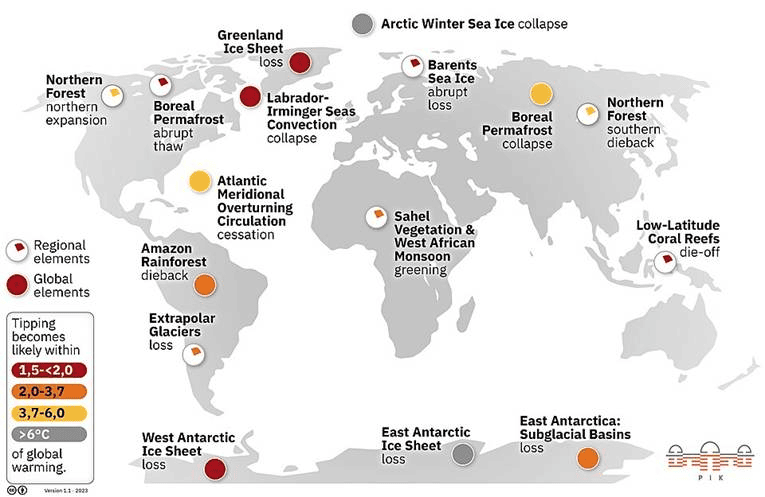
Figure: Climate tipping points are approaching faster than once assumed, with systemic risks for cities. Scientists now identify at least nine major tipping elements that could be triggered well within the Paris Agreement's 1.5–2°C range, some potentially in the years ahead. City planners should consider these tipping points when addressing greenhouse gas mitigation and capital investment (Attribution PIK; CC BY 4.0).
Why the old tools keep underperforming
Carbon taxes and emissions trading schemes are built on a century-old idea from Arthur Pigou: price the damage, and markets will correct themselves. It's elegant, but I also believe that it’s incomplete. Pricing emissions has proven politically combustible almost everywhere it's been tried at scale, and voluntary carbon markets have been dogged by credibility problems, with independent reviews finding that many forestry offsets deliver only a fraction of their claimed benefit.
In my working paper, Carbon Reward Policy: An Economic Framework for Responding to Climate Damages & Systemic Risks (Zenodo), I argue that mainstream economics has diagnosed only half the climate problem. Alongside the familiar “negative externality” of unpriced damages, I identify a second failure: a “systemic externality,” rooted in political gridlock and climate feedbacks — a failure that causes the damages and risks to compound. Even when everyone understands the purpose of a carbon price, a cooperation deficit stops proportionate action. I call this a “market-and-system failure” — and it's why penalty-based tools have struggled for thirty years to move the needle.

Photo: Europe was gripped by a historic and deadly heatwave in June 2026, with record-breaking temperatures sweeping across the continent. From Germany's new high of 41.7°C to France's hottest day on record, the scope of this extreme heat event is unprecedented (credit: János Venczák)
A reward, not a penalty
My proposed policy is the Carbon Reward (XCR): a mechanism that pays for verified climate-positive outcomes rather than taxing emissions. It works through a sovereign-backed instrument I've coded as XCR, with a price floor guaranteed by central banks, and it is distributed as performance-based grants. Unlike carbon credits, XCR wouldn't represent ownership of a tonne of carbon for resale or offset; it's a debt-free, bankable instrument for the large mitigation projects that struggle to find scalable finance — including long-payback infrastructure, early-stage decarbonisation, and nature-based solutions like wetland restoration.
For city and infrastructure leaders, the appeal is practical. A reward-based instrument is additive: it requires no new business taxes or fiscal cost on governments, it can operate alongside existing carbon markets and the Paris Agreement’s Article 6, and it rewards co-benefits — equity for communities, biodiversity for ecosystems — alongside emissions performance. That speaks directly to the pressures that city leaders juggle: attracting capital for urban innovation, building the business case for smart infrastructure, and delivering resilience. If there is no fiscal cost for government, and no tax on businesses or households, then who pays? Through XCR, the mitigation cost is spread throughout the global financial system by crowding out non-XCR investments, and through a calibrated level of monetary inflation designed to be diffuse and manageable.
Why now
Three developments make this a live moment. Article 6 has opened new space for cross-border market cooperation. Central banks and development finance institutions are paying closer attention to climate risk than at any point in the last decade. And the shortcomings of existing carbon tools are now well documented, creating intellectual appetite — among economists, regulators, and investors — for a genuinely new instrument.
The cultural resonance still catches me by surprise. The concept entered popular culture through Kim Stanley Robinson's novel, The Ministry for the Future, which portrays the fictional “carbon coin” — inspired by my early research on the carbon reward. I had no hand in writing the novel — but it's been humbling to watch society catch up with the carbon reward concept.
The invitation: help build the evidence
I'm not asking anyone to take this new financial concept on faith. I'm convening a new interdisciplinary Working Group of cities, governments, corporations, and NGOs to co-fund an independent feasibility study — the essential step before any credible pilot programme.
This is a ground-floor opportunity for Smart Cities Council partners. Organisations joining at the Foundation Stage shape the study's scope, gain early visibility into a mechanism that could reshape climate finance, and position themselves as first movers if evidence supports pilot programmes.
I invite expressions of interest from city councils, governments, corporations, and NGOs who want to help determine whether the Carbon Reward can deliver. If your organisation explores innovative climate finance, builds the business case for large-scale sustainability investment, or seeks cross-sector partnership on regenerative economics, I hope you'll engage before the study's direction is set.
I would be happy to share our Carbon Reward Philanthropic & Funding Brief with prospective partners. This brief sets out the programme structure, budget, and funding tiers in accessible detail, and I would also be happy to answer your questions about the Version 4 working paper at https://zenodo.org/records/21211654.
The climate finance gap is measured in USD trillions. I’m confident that the Carbon Reward can close this gap — but to convince policymakers and national leaders we need a professional feasibility study. I'd welcome your support to test the policy, and to have you in the room while that evidence is built.

Contact
Dr Delton Chen (Executive Director)
Global Carbon Reward (GCR) / Inquiring Systems, Inc. 501(c)(3)
partnering@globalcarbonreward.org
https://globalcarbonreward.org/
Reference
Chen, D. (2026). Carbon Reward Policy: An Economic Framework for Responding to Climate Damages & Systemic Risks (4.0.0). Zenodo. https://doi.org/10.5281/zenodo.21211654
Appendix. New Ideas in Economics
Here is a list of the major new economic ideas presented in Chen (2026):
● Financial instrument: The paper proposes a new asset type, called a ‘carbon reward’ (XCR) — that is not a currency, credit, or bond. It is a sovereign-backed, ISO 4217-style instrument (alongside XAU, XDR) for financing long-term climate mitigation. It diffuses the mitigation cost across the global financial system, and it does not transfer carbon ownership, thereby avoiding offset credibility problems.
● Monetary policy: Carbon quantitative easing (CQE) would have allied central banks buy XCR to defend a price floor. Unlike Modern Monetary Theory (MMT), it’s bounded by a quantity requirement rather than an inflation target, with no institutional merger of fiscal and monetary roles.
● Externalities: A new thesis splits carbon’s harm into the familiar ‘negative externality’ (the social cost of carbon) and a new ‘systemic externality’ (the ‘risk cost of carbon’). This theory dissolves the intractable problems with the social discount rate and ‘fat tailed’ risk.
● Risk and decision theory: The social cost of carbon is shown to become statistically unusable once political resistance and tipping points are included — its tail never closes. The ‘risk cost of carbon’ instead prices the remedy, not the harm, sidestepping the social discount rate problem.
● The growth debate: Rather than taking sides on green growth versus degrowth, the paper reframes growth as ‘compositional’ — dependent on how markets are managed — yielding a pragmatic ‘carbon-balanced agnostic-growth’ development pathway, instead of degrowth or green growth.
● Thermodynamics: The paper reinterprets Daly’s steady-state economy as a ‘hybrid model.’ The problem is that Daly’s model is a hybrid social-biophysical model and not a true biophysical model, lacking a definable open boundary. The solution is a new meta-system model of thermodynamic ‘control volumes’ embedded in the carbon cycle.
Dr Delton Chen, founder of the Global Carbon Reward think tank. With a background in engineering, he brings a pragmatic, systems-oriented mindset to climate economics — recently publishing the 4th version of his Carbon Reward policy as a rigorous framework for managing climate costs and systemic risks.
For more information on Smart Cities Council programs: