
Author: Andrew J. Cary, Co-Founder and CEO of SNAAP Transportation
For nearly a century, urban development has been dictated by a single, unwavering metric: vehicular throughput. When traffic builds, the traditional response from planning departments has been uniform — expand highways, widen intersections, and optimize traffic signals to shave seconds off the morning commute. Yet, despite billions of dollars funneled into these massive public works, congestion has only intensified, while urban spaces have grown increasingly fractured, polluted, and detached from human scale.
The hard truth that municipal leaders, policymakers, and urban planners must confront is this: congestion is not the disease; it is merely a symptom.
The true underlying crisis is structural. Our modern cities were fundamentally designed around the geometric requirements of the automobile rather than the biological and social needs of human beings. When 80% of vehicles gridlocking our metropolitan centers carry only a single occupant, the status quo becomes mathematically unsustainable. To build the resilient, prosperous communities of tomorrow, we must shift our foundational paradigm. We must stop trying to move cars more efficiently and start focus entirely on how we move people.
The Induced Demand Paradox: Why Adding Lanes Fails
When a city expands a roadway, it effectively reduces the "price" of driving by making it temporarily faster. This temporary relief attracts drivers who previously took alternative routes, traveled at different times, or forewent the trip altogether. Within a few years—sometimes even months—the new lanes are just as congested as the old ones. This is the law of peak-hour highway congestion: building more road capacity to cure traffic is like loosening your belt to cure obesity.
The core issue is that expanding the footprint of vehicular infrastructure consumes the very urban fabric that makes cities vibrant. Valuable land that could be utilized for housing, commerce, or parks is permanently paved over for travel lanes and parking lots. By dedicating immense spatial capital to the automobile, cities inadvertently create a feedback loop that forces automobile reliance, worsens urban sprawl, and drives up long-term infrastructure maintenance costs.
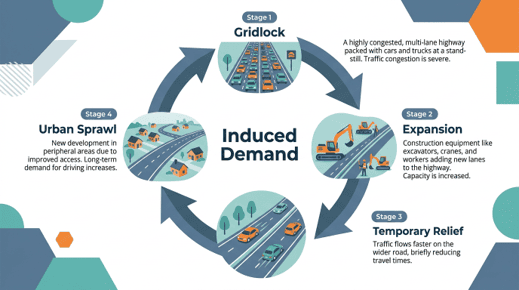
Picture: The vicious cycle of induced demand, courtesy of Nano Banana 2
Transportation as Economic Infrastructure, Not Public Works
For too long, transportation has been bucketed as a traditional "public work" — a necessary cost center funded by tax revenue, evaluated primarily by its engineering specifications and line-item expenditures. This narrow framing obscures its true function. Transportation is the foundational economic infrastructure of a city. It is the physical framework that connects labor markets, dictates property values, and determines the velocity of local commerce.
When a transit system functions poorly, it acts as a regressive tax on the city’s population. Wasted hours spent sitting in gridlock translate directly into lost productivity, depressed economic output, and reduced municipal competitiveness. Furthermore, traditional transit models often suffer from a stark binary:
●Mass Subways and Heavy Rail: While highly effective at moving large volumes of people, they are prohibitively expensive, disrupt local ecosystems during construction, and require decades to deploy.
●Cars and Surface Micro-mobility: Highly flexible but inherently bound to the existing, congested surface street grid, making them highly vulnerable to accidents and systemic delays.
True economic resilience requires addressing the critical "missing middle" of urban mobility: transit systems that offer the point-to-point flexibility of a personal vehicle but operate on cost-effective, high-throughput architectures decoupled from surface gridlock. When infrastructure spending is reevaluated through the lens of economic optimization — measuring the return on investment (ROI) via human access rather than vehicle speed — the case for sprawling surface road networks collapses.
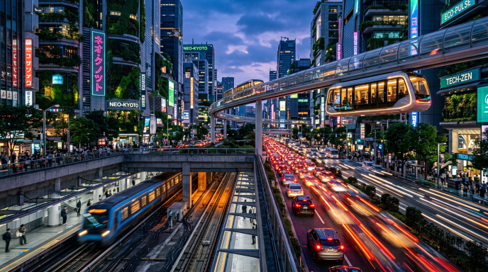
Picture: Layered city scape at twilight, courtesy of Nano Banana 2
Designing for Accessibility vs. Automobile Ownership
Automobile ownership is an incredibly inefficient model for urban spatial design. A private car spends roughly 95% of its lifespan parked, occupying valuable real estate in downtown cores and residential neighborhoods. When moving, a standard sedan requires approximately 100 to 150 square feet of space to transport a single individual.
Human-centered urban planning requires shifting the metric from mobility (the speed at which a vehicle can travel) to accessibility (the ease with which a human being can reach a destination).
Designing for accessibility means reclaiming the streetscape. When cities prioritize grade-separated or dedicated right-of-way travel corridors, they isolate transit from unpredictable surface interactions. Moving transit off the road network entirely — whether underground or via lightweight, elevated closed-loop networks — yields two massive strategic benefits:
- Guaranteed Continuous Flow: Eliminating interactions with pedestrians, traffic lights, and cross-traffic completely eliminates the primary catalysts of urban gridlock.
- Land Reclamation: By taking transit vertical or keeping it completely separated, the surface level can be re-architected for active transportation (walking and cycling), green spaces, and high-density commercial development.
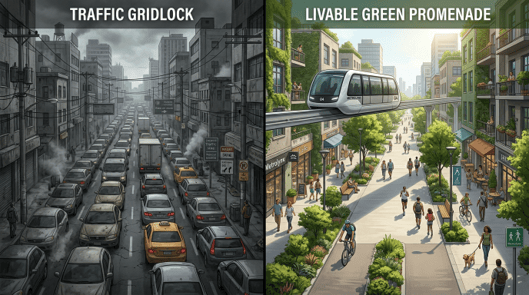
Picture: The difference between one-layered and vertical integrated street scapes, courtesy of Nano Banana 2
Mobility as a Quality-of-Life Indicator
The layout of our transportation networks shapes the health, social fabric, and well-being of our citizens. Car-heavy societies face severe public health externalities, ranging from elevated rates of respiratory illness caused by tailpipe emissions ($CO_2$ and $NO_x$) to rising trends in sedentary lifestyles. Furthermore, traffic accidents remain one of the leading global causes of preventable injury and death.
Beyond physical health, the psychological toll of the modern commute is staggering. Long, unpredictable drives in dense traffic are consistently linked to elevated cortisol levels, increased stress, and lower overall life satisfaction. When a worker must spend 45 to 50 minutes navigating a congested 8-mile surface route via bus or personal vehicle, they are losing hours every week that could be spent with family, pursuing education, or engaging with their community.
A human-centered city views seamless transit as a baseline public utility that safeguards time. If that same 8-mile trip can be bypassed via a grade-separated, autonomous network in under 10 minutes, the city has not just optimized a route — it has given its citizens their lives back.
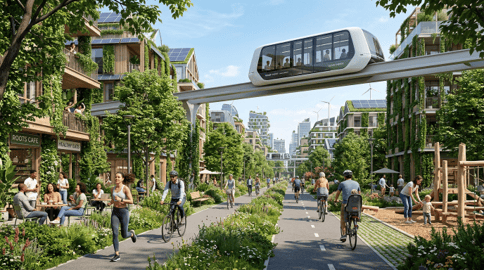
Picture: The wellness promenade with vertical integration, courtesy of Nano Banana 2
The Next Generation of Human-Centered Mobility Ecosystems
To build the next generation of urban mobility, leaders must move beyond the constraints of traditional asphalt and large-passenger diesel buses. The future belongs to modular, autonomous, and vertically integrated networks that dynamically scale based on real-time human demand.
Instead of forcing passengers to adapt to rigid, fixed-route transit schedules that operate on high headways (waiting 20 minutes for a train or bus), modern infrastructure must adapt to the passenger. A truly human-centered ecosystem relies on small-footprint, specialized autonomous units operating on closed-loop tracks.
By deploying grade-separated networks that cost a fraction of traditional light rail or subways (e.g., targeting ~$8 million per mile rather than hundreds of millions), municipalities can realistically scale transit across sprawling modern footprints without taking on catastrophic, generational debt.
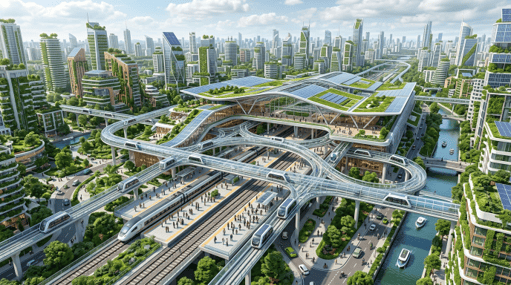
Picture: Seamless hub integration - the complete network, courtesy of Nano Banana 2
A Strategic Framework for City Leaders
For civic leaders and policymakers, transitioning from a vehicle-centric paradigm to a human-centric one requires immediate, actionable shifts in strategy:
●Implement Spatial Audits: Evaluate city zoning and right-of-ways based on spatial efficiency. Calculate how much land is dedicated to storing stagnant vehicles versus moving people, and aggressively rezone parking minimums to incentivize transit-oriented developments.
●Target the "Single-Occupant" Root Cause: Stop building infrastructure that implicitly encourages solo driving. Prioritize transit investments that directly capture the 80% of commuters traveling alone, offering them a private, point-to-point alternative that matches the convenience of a personal car without the associated surface footprint.
●Champion Grade Separation: When evaluating new transit corridors, favor solutions that completely bypass the existing road grid. Surface-level fixes are inherently constrained; true flow requires utilizing the vertical dimension to separate mass movement from neighborhood streetscapes.
●Decentralize Through Modular Procurement: Move away from monolithic, high-risk infrastructure projects that take decades to yield results. Look toward modular licensing, localized micro-manufacturing, and private-public partnerships that allow transit segments to be deployed incrementally, proving out high-usage ROI within months rather than years.
Conclusion
The goal of urban transportation should not be to build a more efficient grid for machines. The goal must be to build a seamless, invisible network that dissolves distances, preserves human time, and fosters community health.
When we stop viewing transportation as an engineering challenge centered on the automobile and begin viewing it as an economic development and community well-being strategy, our choices become clear. It is time to stop paving our cities and start designing them for the people who live in them.
Key Takeaways for Policymakers
●Induced demand dictates that widening roads will never cure traffic congestion; it only increases vehicle dependency and municipal maintenance backlogs.
●True accessibility measures the ease with which citizens can reach their destinations, not the speed at which single-occupant cars pass through an intersection.
●Decoupling transit from the surface street grid via lightweight, grade-separated autonomous corridors offers a cost-effective path to absolute continuous flow.
●Transitioning to modular, agile infrastructure assets allows cities to scale transit networks incrementally while stimulating local workforce development.
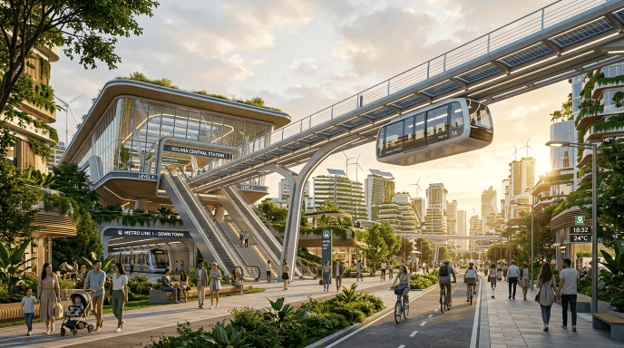
Picture: The seamless integration of all levels of transportation, courtesy of Nano Banana 2

About the Author
Andrew Cary has nearly 40 years working in the public, private & non-profit sectors. He served as a public educator & senior administrator, an executive director and board member of multiple non-profits and as a global strategist, edtech leader & business developer.
Now, as CoFounder/CEO SNAAP™ Transportation, Andrew leverages his decades of entrepreneurial tenacity, innovation & business acumen to bring this sustainable alternative to personal transportation to the global market.
Andrew has helped numerous education, edtech startups & large companies go to market, grow share of wallet to exit. He has successfully managed the layered relationships across organizations, channels, partners & markets. He maintains deep and lasting relationships in LatAm, Greater Europe & APAC.
Presently, through his corporate business line Future Educational Options and Cary Enterprises LLC, Andrew serves in strategic leadership, advisory & direct engagements for global partners, ministries and departments of education and a variety of other private & public sector service providers. Additionally, serves as an advisor and coach for the Chambers of Commerce, StartEd in New York, Sykes Business School, UT Lowth Entrepreneur Center & numerous startups. He maintains offices in the US and Sao Paulo and looks to expand to Dubai in 2025.
For more information on Smart Cities Council programs: