
Authors:Tom Kubank & Kristen Kubank, Co-founders, TestInvest
Why capability verification matters
Cities and the organizations that build them increasingly run on software. Design, scheduling, estimating, compliance, finance, cyber security and asset management systems now sit at the center of how infrastructure is planned, delivered and maintained. Every one of these systems depends on people who can operate them effectively.
Yet despite the growing reliance on digital tools, most technical hiring decisions continue to rely heavily on resumes, interviews and reference checks. While these methods provide valuable insight into experience, communication and cultural fit, they do not independently verify whether a candidate can actually perform the software workflows the role requires.
The gap matters more today than ever before. As AI changes workforce structures, teams become leaner and employees are expected to work across multiple software platforms, every technical hire carries greater operational responsibility. Capability gaps that go unnoticed during recruitment often emerge only after projects are underway, creating delays, increased costs and operational risk.
Rather than simply recruiting experienced people, organizations are increasingly asking a different question:
Can this person actually demonstrate the digital capability our projects depend on?
Why it matters for Smart Cities and Infrastructure
As cities become increasingly digital, the success of infrastructure projects depends not only on technology, but on the capability of the people implementing and operating it. From digital twins and AI platforms to asset management systems, cyber security, engineering design and transport technologies, software proficiency has become a critical component of project delivery.
Governments, infrastructure owners and industry are investing heavily in digital transformation, yet recruitment processes often continue to rely on resumes and interviews rather than independently verifying technical capability. As teams become leaner and employees take responsibility for increasingly complex digital systems, the risk associated with capability gaps continues to grow.
For city leaders, project owners and employers, improving workforce capability is about far more than recruitment. It is about reducing implementation risk, improving project outcomes and ensuring critical infrastructure is supported by people with the skills needed to deliver.
The following Australian case study demonstrates how independent software skills verification strengthened a technical recruitment process and highlights lessons that are increasingly relevant across infrastructure, government and smart city projects.
A case study: Verifying an Australian construction-sector placement
Earlier this year, Hughes Recruitment Partners, a South Australian recruitment agency specialising in technical and professional roles, was engaged to recruit a software engineer for a leading self-perform construction services company headquartered in South Australia.
SQL proficiency was an important requirement of the role.
Rather than relying solely on resume claims and interview performance, Hughes Recruitment Partners used the TestInvest software skills verification platform to independently assess the candidate's capability before presenting them to the client.
The verification step was not requested by the client. It was introduced because the recruitment team recognised that technical hiring is changing. Teams are becoming leaner, software is embedded across more roles, and employers are less willing to absorb the cost and disruption of a poor technical hire.
Independent capability verification strengthened the recommendation by replacing assumption with measurable evidence.
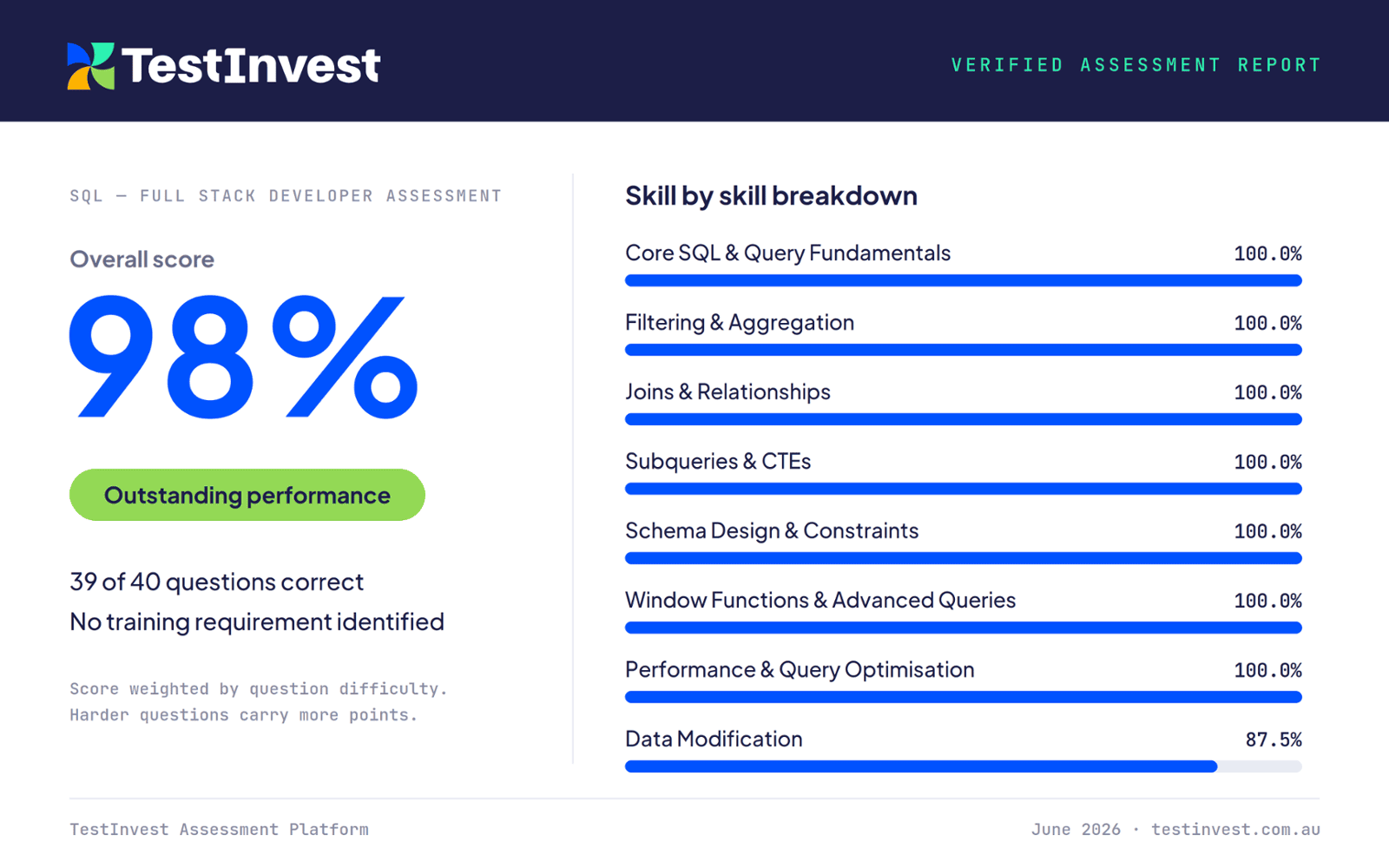
Extract from the candidate's verified TestInvest SQL assessment report.
How it strengthened the placement
The assessment fundamentally changed the discussion with the client.
Instead of asking the employer to rely on interview impressions and resume claims, Hughes Recruitment Partners could present independently verified evidence of the candidate's demonstrated capability, areas of strength and any potential development requirements.
The additional confidence strengthened the recruitment recommendation.
The candidate was subsequently appointed and remains successfully employed in the role.
Implementation realities
Three practical lessons emerged from this project.
First, verification must integrate into existing recruitment workflows. The assessment formed part of the normal screening process. Candidates completed it remotely, reports were available before presentation to the client, and no additional systems or workflow redesign were required.
Second, assessment integrity is essential. Capability scores only have value when employers can trust that they genuinely reflect the individual's skills. Secure assessment conditions and independently verifiable results transform testing from another document into a meaningful recruitment decision-making tool.
Third, capable candidates benefit from the opportunity to demonstrate their skills. Independent verification helps distinguish genuine capability from self-reported experience, while personalised proficiency plans provide practical guidance for future development regardless of recruitment outcomes.
Implications for industry
The lessons extend well beyond recruitment.
As organizations become increasingly dependent on digital platforms, independently verifying technical capability is becoming another form of operational risk management.
Whether delivering transport infrastructure, operating utilities, managing smart buildings or supporting government digital services, organizations benefit when technical capability is measured rather than assumed.
More informed hiring decisions reduce implementation risk, minimize capability gaps and strengthen workforce readiness before critical projects begin.
The forward view
As AI continues reshaping workforce structures and expanding the number of digital tools used across many professions, individual employees will carry greater responsibility across increasingly complex software ecosystems.
That concentration of responsibility increases the importance of making the right technical hire.
Organizations that incorporate capability verification into recruitment are doing more than adopting another assessment tool. They are adapting to a labour market where demonstrated capability increasingly outweighs claimed experience.
Key takeaway
Resumes describe experience.
Interviews assess communication and organisational fit.
Neither independently verifies capability.
As cities, governments and industry become increasingly dependent on digital technologies, organisations that verify what candidates can actually do before making an appointment can reduce hiring risk, strengthen project delivery and build greater confidence in their workforce.

About the Organization
TestInvest is an Australian software skills verification platform that helps employers and recruiters independently verify software capability before and after employment.
Candidates complete scenario-based assessments based on real workplace workflows. Employers receive independently verified reports featuring difficulty-weighted proficiency scores, detailed capability breakdowns, personalised learning pathways and verifiable certificates.
TestInvest currently offers 23 assessments across accounting, finance, cyber security, software development, healthcare, real estate and other software-intensive industries, with custom assessments available for organizations requiring role-specific capability verification.
Learn more at www.testinvest.com.au or app.testinvest.com.au.
For more information on Smart Cities Council programs: