
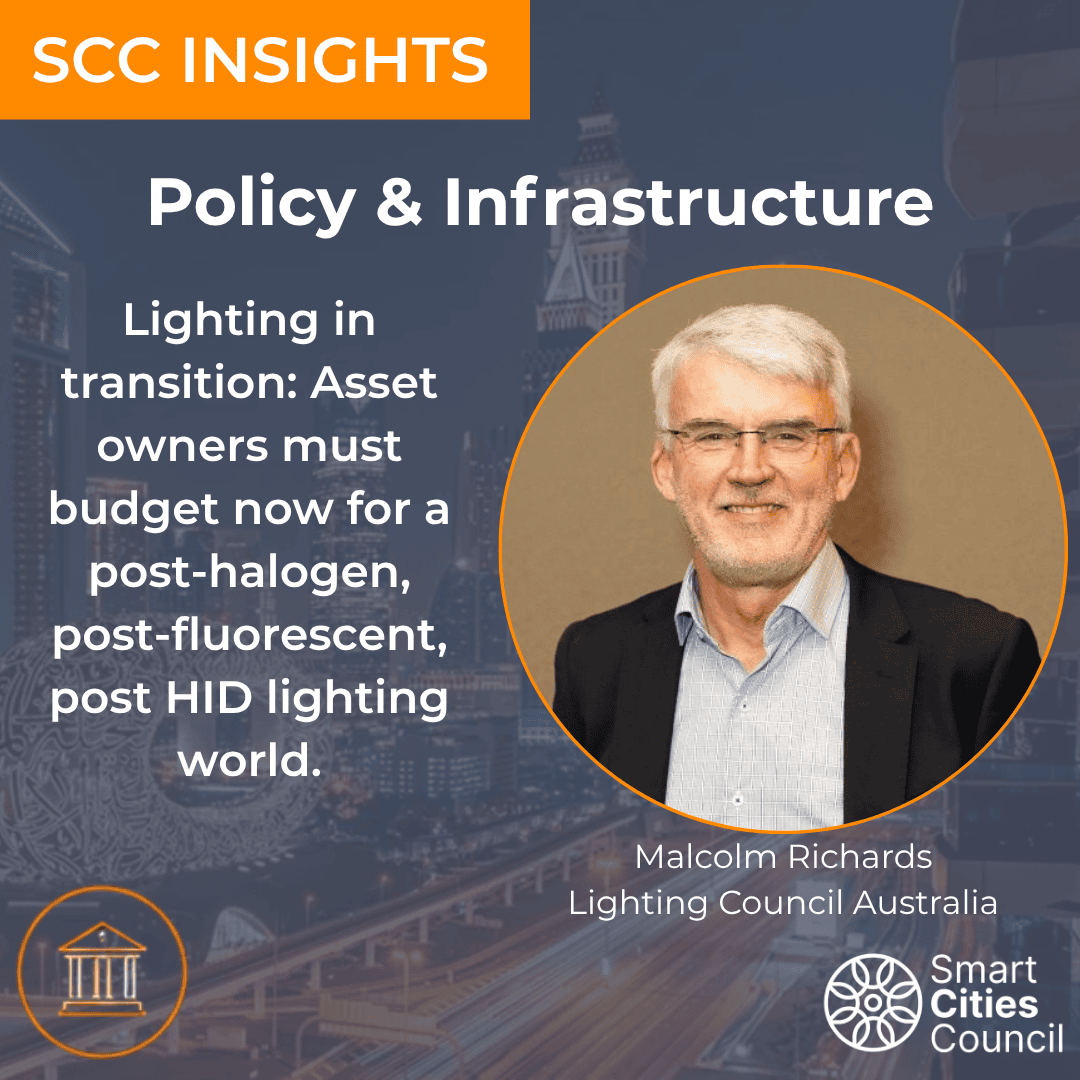
By Malcom Richards, CEO Lighting Council Australia
Australia is quietly passing a turning point in how its cities, towns and regions are lit. Over the past 15 years, a mix of domestic regulation and international agreements has set a clear direction: Inefficient and mercury‑containing lamps are on their way out, and LED has become the default technology for streets, buildings and public spaces.
This is no longer a technical detail buried in procurement specifications. It is a live asset and budget risk that touches roads and transport, schools and hospitals, precincts and community facilities. Continuing to rely on halogen, fluorescent and many high‑intensity discharge (HID) lamps such as metal halide and high pressure sodium will soon be impossible.
How we got here: from legacy lamps to modern standards
Australia’s shift away from traditional lamps has been deliberate and staged. Early efforts focused on incandescent bulbs, which were progressively removed from the market as more efficient alternatives became available.
Attention then turned to halogen, fluorescent and HID technologies. The Australian Government has now confirmed a timetable to phase out many of these lamps under energy efficiency and mercury‑reduction rules. In practice, this means:
- Import cut‑off dates for most incandescent and halogen lamps has now passed, with only narrow exemptions for specialist products.
- A progressive phase‑out of compact fluorescent and linear fluorescent lamps from 2025 through to the end of 2027.
- A defined pathway to remove metal halide and high‑pressure sodium lamps from the market by 2030.
These are not instant “switch off” dates for existing assets. Instead, they mark the last legal points for importing affected lamps. After warehouse and retail stocks are exhausted, replacement lamps will become essentially impossible to purchase, For councils, government decision-makers, industry leaders, infrastructure and building owners, maintenance contractors and building designers that still depend on legacy technologies, the familiar “keep buying lamps as we need them” approach will simply not hold.
LED becomes the new baseline – and it’s regulated.
As older technologies are phased out, LED has rapidly moved from an emerging option to the mainstream solution. LEDs are now widely used across local roads, state‑controlled arterial routes, public/private buildings, transport hubs, schools, hospitals and open‑space lighting.
Recognising that LED is now the dominant technology, the Australian Government has introduced the Greenhouse and Energy Minimum Standards (GEMS) Determination 2025. This brings in‑scope LED lamps under the GEMS regime, setting minimum requirements for energy performance, product performance and labelling. LED lamps imported after early March 2026 and covered by the Determination must be registered in the Energy Rating Product Registration System before they can be supplied or sold in Australia.
The GEMS Regulator has advised Lighting Council Australia that it is now actively monitoring the market, from online listings to physical retail channels, to check that LED lamp models are registered and compliant. Hundreds of LED models have already been registered, with more under assessment.
Why “just keep buying lamps” is no longer a strategy.
For many years, it was reasonable for asset managers to treat lighting as a straightforward maintenance task: keep the fittings, replace lamps when they fail, and leave major upgrades for another day. In the current policy and market context, that logic breaks down.
First, the supply of common halogen, fluorescent and HID lamps will tighten as import deadlines pass. Price volatility and longer lead times are likely to become the norm. For essential services – local roads, state‑controlled main roads, hospitals, sporting and recreation facilities – that means a real risk of not being able to maintain lighting levels in a timely, reliable way.
Second, LED “retrofit” lamps are not a universal fix. While they can work in some existing fittings, issues such as compatibility, performance, thermal management and safety all need to be carefully assessed. For many public lighting networks and larger facilities, purpose‑designed LED luminaires provide a more robust, future‑proof solution.
Third, treating lighting purely as an operational expense misses an important opportunity. Thoughtful lighting renewal can directly support government priorities in emissions reduction, public safety and amenity, digital infrastructure and smart‑city innovation.
LEDs as smart infrastructure for communities
Modern LED lighting offers much more than lower power bills. When viewed as infrastructure, it can improve community outcomes on multiple fronts.
On energy and emissions, LED systems typically use significantly less electricity than halogen, fluorescent and many HID systems, while delivering equivalent or better lighting outcomes. This makes them a straightforward, scalable contributor to local and state emissions‑reduction targets.
From an operational perspective, the long life of quality LED products reduces the frequency of site visits, traffic management deployments and out‑of‑hours works – all major cost drivers in road and public‑space lighting. Fewer failures mean fewer dark spots and complaints, and more reliable services for communities.
LED also opens the door to smarter services. Smart street lighting systems combine dimmable LED luminaires, sensors, communications technology and advanced metering. This enables not only energy savings and better asset management, but also a wide range of smart city functions. Lighting poles can support digital signage, CCTV, emergency “push to talk” devices and even EV charging, turning each pole into a multi‑service platform.
Because street lighting is ubiquitous, powered and highly visible, it is an ideal backbone for smart‑city applications in areas such as transport, public safety, environmental monitoring and urban services. New Australian Electricity Rules have recently enabled adaptive street lighting metering approaches that are critical to unlocking the full value of smart street lighting for communities and governments.
The policy direction is clear and the timelines are set. The question is how to respond in a way that manages risk and captures value, rather than simply reacting to shortages as they arise.
Practical steps include:
- Audit lighting portfolios across all assets. Map where halogen, fluorescent and HID lamps are still in service across roads, building and other assets. Identify high‑priority sites where lamp unavailability would have the greatest impact on safety or essential services.
- Align asset plans with phase‑out dates. Compare current inventories with the known phase‑out timetable and typical lamp and luminaire replacement cycles. Lighting Council Australia has a phase out timetable available including recommendations on alternatives, in some cases it may be more prudent to plan for luminaire replacement rather than stretching ageing systems further.
- Develop staged LED upgrade programs. Build multi‑year LED upgrade programs that integrate with existing capital works and renewal plans. Prioritise corridors, precincts and facilities where LED can deliver the greatest combined benefits in safety, amenity, energy savings and data capability.
- Embed GEMS compliance in procurement. Require evidence of GEMS registration and compliance with the LED Lamps Determination and other relevant measures when procuring LED products. This supports quality outcomes and reduces whole‑of‑life costs across asset portfolios.
- Incorporate lighting into climate and smart‑city strategies. Ensure lighting transition plans are explicitly linked to net‑zero, resilience and smart‑city strategies at both local and state levels. Doing so can help unlock broader funding, partnerships and community support, and avoid “one‑off” upgrades that miss the opportunity to build integrated, future‑ready systems.
A decisive moment for lighting – and for leadership
Australia’s lighting rules are now at a decisive point. Legacy halogen, fluorescent and many HID lamps are on a clear path out of the market, and LED has become the regulated mainstream technology. This represents far more than a simple product swap.
Handled well, it is an opportunity to move beyond reactive lamp replacement and build modern, efficient and data‑ready lighting systems that deliver better value and better services to communities. Handled poorly, it risks exposing essential services to avoidable supply disruptions, higher costs and missed opportunities for innovation.
The window for proactive planning is open now. The organisations that act early – auditing their portfolios, budgeting and aligning plans with phase‑out dates and integrating lighting into wider climate and smart‑city agendas – will be best placed to control costs, manage risk and unlock the full potential of this transition.
About Lighting Council Australia
Lighting Council Australia is the peak industry body representing Australia’s lighting sector, advocating for high-quality, energy-efficient, safe and sustainable lighting solutions across the built environment. Established in 2001, the organisation brings together manufacturers, suppliers, designers and industry stakeholders to promote best practice, support innovation and drive positive industry outcomes.
Through advocacy, education, training and industry collaboration, Lighting Council Australia works closely with government, regulators and standards bodies to influence policy, improve compliance and elevate industry standards. The organisation champions environmentally and socially responsible lighting while supporting members through technical guidance, networking opportunities, accreditation programs and access to the latest regulatory developments.
As the recognised voice of the Australian lighting industry, Lighting Council Australia plays a vital role in advancing lighting technologies that enhance safety, sustainability, energy efficiency and liveability in communities across Australia. Its commitment to quality, innovation and industry leadership helps shape a brighter and more sustainable future for the built environment.
For more information on Smart Cities Council programs: