
Article by Len Costantini / Tremendi
For city leaders, mobility innovators, public infrastructure operators, and anyone preparing for autonomous systems to move into shared environments.
Following our recent Founder in Focus on SNAAP Transportation, which explored how cities can rethink mobility by targeting high-friction bottlenecks, this third edition shifts focus to an equally critical challenge: trust. As autonomous systems—from drones to AI agents and smart machines—move rapidly into shared environments, the question is no longer just what they can do, but how they are governed. Helixis Technology brings this issue to the forefront, highlighting the urgent need for an accountability layer that ensures autonomy can scale safely, transparently, and in alignment with public expectations.
In this Founder in Focus, Len Costantini, Managing Director at Tremendi, sits down with Twyla Jackson to explore trust, accountability, and why the future of autonomy depends on more than technology alone. Jackson unpacks why intelligence must be matched with governance, how cities and operators should approach trust and liability, and what it will take to move from experimentation to scalable, real-world deployment.
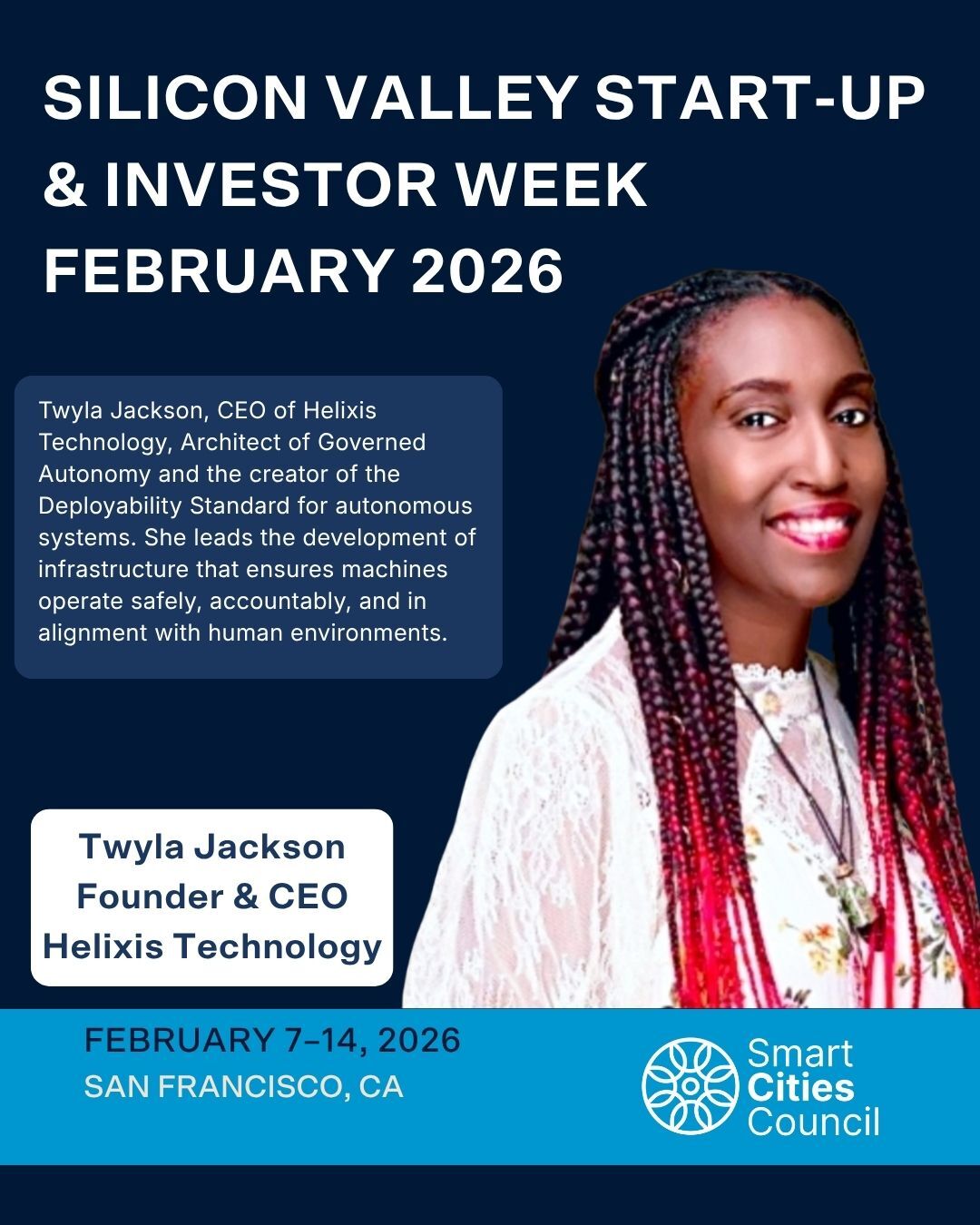
From NASA’s technology transfer ecosystem to trusted autonomy, Helixis founder and CEO Twyla Jackson is building the accountability layer cities will need to confidently manage the next generation of automation.
Autonomy is moving from concept to reality. Drones, AI agents, smart machines, and autonomous vehicles are arriving faster than many cities, institutions, and operators can govern them. That is where Helixis enters the conversation.
Helixis Technology, is focused on a challenge that is easy to overlook but increasingly hard to ignore: if autonomous systems are going to scale in public life, who makes sure they are accountable, auditable, and aligned with human rules?
That question sits at the heart of Helixis’ work - as a civic infrastructure business building the Autonomous Trust Infrastructure (ATI) — a framework designed to connect policy, identity, consent, and behavior across autonomous systems.
In practical terms, it is about helping ensure that emerging technologies can operate in shared environments without outpacing public trust, safety, or governance.
Q&A with Twyla Jackson, Founder and CEO, Helixis Technology
1. For readers discovering Helixis for the first time, what is the core problem you are solving?
Autonomous systems are advancing quickly, but the governance layer around them is not keeping pace. Helixis was created to help close that gap. We are focused on making machine behavior more accountable, explainable, and aligned with human policy before autonomy scales in ways that outstrip public trust.
2. Helixis sits in a fascinating space between technology, policy, and public infrastructure. What drew you to that intersection?
I have always been interested in how powerful systems affect real people in real environments. With autonomy, the question is not only what machines can do. It is whether they can operate safely, fairly, and transparently in places shared with society. That is where infrastructure, governance, and trust become essential.
3. Helixis references NASA’s technology transfer ecosystem and NVIDIA Inception. How have those connections shaped the company’s journey?
Being part of NASA’s Technology Transfer ecosystem influenced how we think about systems.
NASA operates with what I would call space-grade logic , systems are designed with verification, redundancy, and mission assurance in mind because failure isn’t an option. That mindset shaped Helixis from the beginning. When autonomous systems begin operating in public environments, the same discipline around reliability and accountability becomes essential.
The NVIDIA Inception ecosystem complements that from the other direction. It connects us to the computational and AI infrastructure that is driving autonomy forward.
4. You talk about “trust infrastructure.” What does that mean in plain English for a city leader or operator?
Trust infrastructure simply means giving cities a reliable way to know which autonomous systems are operating, what rules they must follow, and what evidence exists if something goes wrong. Instead of relying on individual operators to self-report behavior, it creates a neutral governance layer that verifies machine identity, applies local policies, and records accountability. For a city leader or campus operator, it means autonomy can scale in public space with clear oversight, evidence, and trust rather than uncertainty.
5. Why is this issue becoming more urgent now?
Because deployment is accelerating. The technology is improving, investment is growing, and more use cases are moving into public and semi-public environments. That creates pressure on cities, campuses, insurers, and operators to make decisions before the supporting frameworks are fully mature.
6. One of the most interesting ideas in the autonomy conversation is that “insurable” often becomes another word for “scalable.” How do you think about liability and insurance?
That is exactly right. If systems cannot be understood, audited, or evidenced, they become harder to insure and harder to scale responsibly. Neutral auditability is important because it can help reduce disputes, clarify liability, and give stakeholders more confidence without forcing cities to become surveillance operators.
7. For cities being asked to approve autonomy in shared space, what should they be thinking about beyond the technology itself?
They should be asking how policy will be enforced, how consent will be handled, what evidence will exist when incidents occur, and who carries responsibility across the chain. The technology matters, but so does governance, accountability, and public legitimacy.
8. Helixis often speaks to the idea that autonomy should not outpace democratic control. Why is that important?
Because public environments belong to people. New technologies should work in service of communities, not around them. If cities and institutions are expected to host autonomous systems, they need mechanisms that preserve agency, dignity, and oversight.
9. What does success look like in the early stages of adoption?
Success in the early stages means autonomy entering real environments with clear rules, accountability, and human oversight, much like the role institutions such as the FAA or Visa play in their systems. Cities, campuses, and operators can approve deployments knowing there is a structured way to verify behavior, resolve incidents, and maintain public trust. At the same time, it ensures autonomy expands dignified work and human agency, creating new roles in oversight, operations, and governance rather than removing people from the system entirely.
10.What kinds of conversations are you having with potential partners or adopters right now?
There is strong interest from organizations that can see the opportunity in autonomy but also understand the operational and governance risks. The most constructive conversations usually come from people asking how to prepare responsibly, not just how to move fast.
11.For a city administrator, utility, campus, or infrastructure operator reading this, what is a practical first step?
Start by identifying where autonomy is likely to appear first in your environment and what decisions you would need to make to allow it. That helps clarify the governance, accountability, and trust requirements before deployment pressure arrives.
12.Looking ahead, what excites you most about the future Helixis Technology is helping build?
What excites me is the possibility of making innovation more worthy of public trust. We do not need to choose between progress and trust. Accountability before growth. Reliability before scale. If we build the governance layer correctly, autonomous systems can operate responsibly across America, across borders, and eventually beyond Earth.
Why this matters
Automation governance matters because autonomous systems are not being deployed in a vacuum. They are entering public roads, shared spaces, infrastructure networks, campuses, logistics environments, and other settings where safety, liability, public trust, and operational accountability all matter.
Without clear governance, the risks are practical as much as technical: uncertainty around who is responsible when something goes wrong, weak evidence for insurers or regulators, poor alignment with policy, and reduced public confidence in adoption. In other words, the challenge is not just whether autonomous systems can operate. It is whether they can operate in ways that are trusted, explainable, and governable.
That is why this conversation matters for smart cities, public agencies, mobility innovators, insurers, infrastructure owners, and technology partners alike. The question is no longer whether autonomous systems are coming. It is whether the systems around them are ready.
Contact Helixis
To learn more about Helixis Technology and its work in trusted autonomy, and to contact the team, visit helixistechnology.com.
For more information on Smart Cities Council programs: