
ZIGURAT Institute of Technology
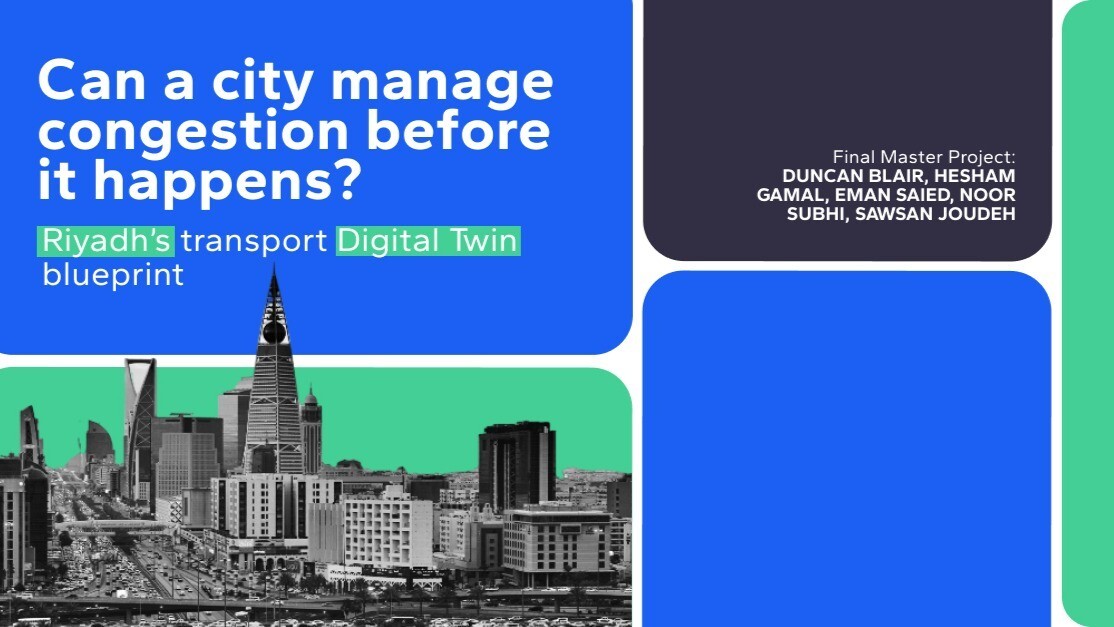
This article explores a Digital Twin Framework for Transportation Management developed as a Final Master’s Project within ZIGURAT’s Smart City Management programme. Designed specifically around Riyadh’s unique urban, technological, and governance context by a collaborative team of students and their mentor, this innovative blueprint offers a scalable solution to the challenges of modern urban growth. It serves as the foundation for the following analysis on how data-driven foresight can transform future mobility.
What Riyadh’s transport digital twin reveals about the future of predictive urban mobility
For decades, congestion has been treated as an unavoidable consequence of urban growth — something cities respond to once it appears, rather than anticipate before it takes shape.
A crash blocks a corridor. An event generates unexpected demand. A new district shifts travel behaviour. A disruption in one part of the network creates pressure elsewhere. In most cases, the response remains reactive: monitor the problem, assess the impact and adjust operations where possible.
But what if cities could do more than respond? What if they could begin to understand, simulate and manage congestion before it materialises?
That is the promise of the transport digital twin.
A recent article examining Riyadh’s transport digital twin blueprint offers an important example of how cities may begin moving from reactive traffic management to predictive mobility planning. It also points to a broader shift in urban thinking: as cities become more complex, digital twins are emerging not simply as a technology layer, but as a tool for understanding mobility as part of a wider urban system.
From static planning to dynamic mobility
Traditional transport planning has long relied on historical data, modelling assumptions and long-range forecasting. Those tools still matter, but they were designed for a world in which cities changed more slowly and mobility patterns were easier to predict.
Today, that context has shifted. Rapid urbanisation, mixed-use development, changing commuter behaviour, freight pressures, platform-based mobility and rising sustainability expectations are reshaping how movement occurs across the city. Transport systems are no longer influenced only by roads and rail lines; they are increasingly shaped by land use, economic activity, digital services and environmental conditions.
From a smart city perspective, this matters because mobility can no longer be understood as a stand-alone transport issue. It is part of a broader urban system. Decisions about transport affect housing, productivity, emissions, equity, public space and the overall experience of urban life. As complexity increases, cities need planning tools that support systems thinking, rather than siloed decision-making.
This is where the digital twin becomes significant.
A transport digital twin is far more than a dashboard or 3D model. At its best, it is a continuously informed digital environment that combines operational, spatial and behavioural data to create a dynamic representation of how mobility functions across the city. It can integrate traffic conditions, public transport activity, incidents, infrastructure performance and land-use patterns into a shared decision-support environment.
Its real value lies not in visualisation, but in simulation. A transport digital twin allows cities to ask: what is happening now, what is likely to happen next, and what would happen if we intervened differently?
Why Riyadh matters
Riyadh is a particularly relevant case because it is undergoing large-scale urban transformation at a moment when mobility planning must respond not only to growth, but to changing ambitions around liveability, economic diversification and long-term resilience.
As the city expands and invests in major transport infrastructure, the challenge is not simply to accommodate more movement. It is to understand how mobility, land use, economic activity and urban form interact over time — and how future transport decisions can be tested before they are implemented at scale.
That is what makes Riyadh’s transport digital twin blueprint so interesting. Rather than treating roads, public transport, parking, development growth and travel demand as separate planning questions, it offers a way to understand them as part of a single, interconnected urban system.
From congestion response to congestion anticipation
The real opportunity of a transport digital twin is the shift from response to anticipation.
Used well, it can help cities anticipate pressure before it becomes disruption, test interventions before implementation, connect planning with operations, and break down mobility silos across roads, parking, public transport, freight and active transport.
This matters because the future of urban mobility is not simply about moving vehicles more efficiently. It is about helping cities understand how different parts of the mobility ecosystem interact — and how decisions in one area can create consequences elsewhere.
More than a traffic tool
It is important not to reduce the transport digital twin to a congestion-management tool alone.
Mobility shapes access to jobs, education, health services, public life and economic opportunity. It influences emissions, productivity, social inclusion and the lived experience of the city itself. When mobility systems fail, the consequences are rarely confined to transport agencies; they affect the city as a whole.
This is why the transport digital twin should be understood as part of a wider urban governance agenda. Its value lies not only in improving traffic flow, but in helping cities better understand the relationship between mobility and land use, infrastructure and liveability, transport and equity, congestion and emissions.
The harder challenge: governance, not software
The appeal of digital twins often centres on technology, but their success depends far less on software than on governance.
The real challenge for cities is not simply whether they can procure a digital twin platform. It is whether they can create the conditions in which such a platform becomes meaningful — including data quality, interoperability, institutional collaboration, privacy, cyber security and decision-making authority.
Without these foundations, digital twins risk becoming impressive visual layers with limited operational value. With them, they can become something far more important: a new form of urban intelligence.
Towards a more predictive city
What makes Riyadh’s blueprint so relevant is that it points to a larger shift in urban management.
For many years, cities have operated in a reactive mode — responding to congestion and disruption after the fact. Digital twins suggest a different possibility: a city that can model, test and anticipate before acting.
That matters not only for transport, but for the future of smart cities more broadly. The cities that lead in the next decade may not be those with the most sensors or dashboards, but those that can turn data into coordinated decisions, connect planning with operations, and build the institutional maturity required to act on insight before problems become crises.
In that sense, the real promise of a transport digital twin is not simply that it may help a city manage congestion. It is that it may help cities manage complexity with greater foresight, confidence and precision.
For readers interested in exploring the Riyadh case study in more detail, the original article provides further insight into the transport digital twin blueprint and the thinking behind this emerging approach to predictive urban mobility.
For more information on Smart Cities Council programs: